
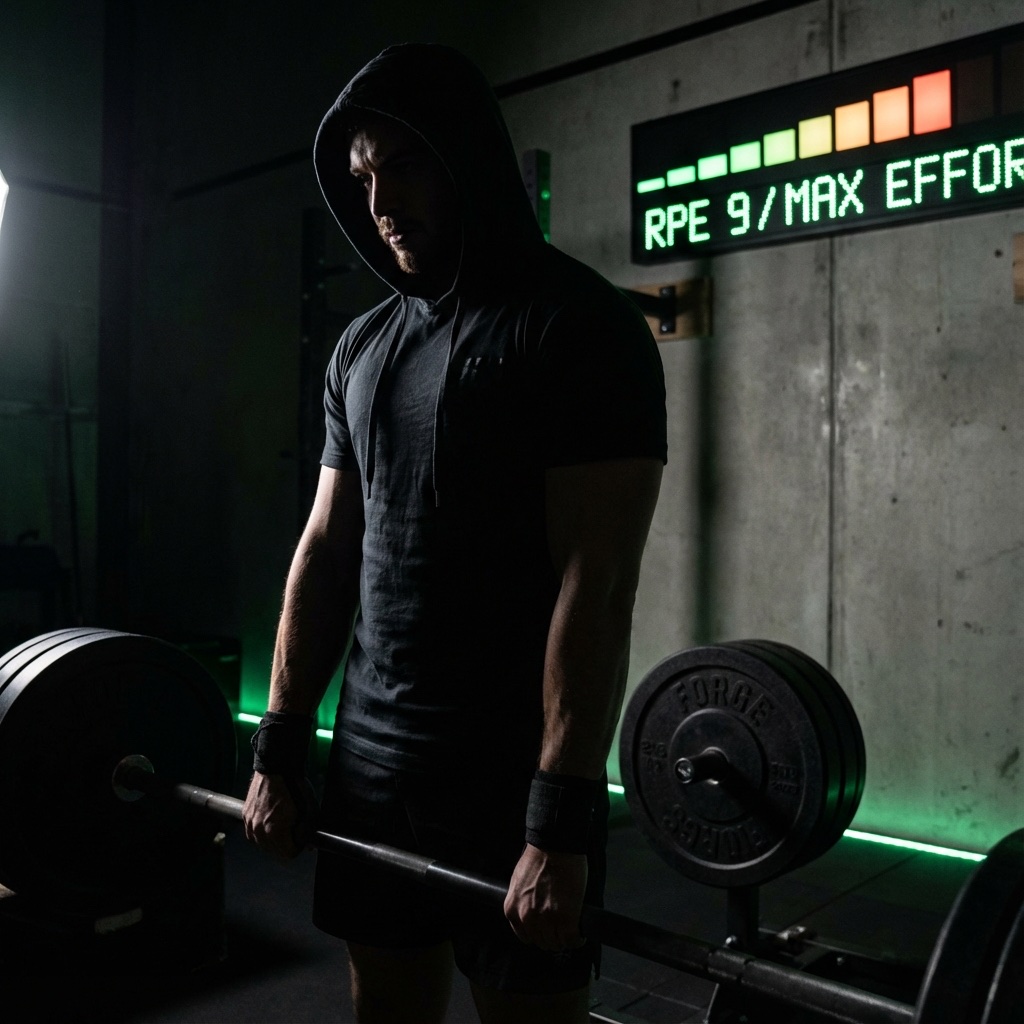
Your program says 80% of 1RM for 5x5. You had four hours of sleep, skipped breakfast, and your knee is acting up. Do you hit the prescribed weight anyway? RPE-based training says no—and that flexibility is why it produces better long-term results.
RPE (Rate of Perceived Exertion) and RIR (Reps in Reserve) are autoregulation tools that adjust training intensity based on how you actually feel, not arbitrary percentages. This guide teaches you how to use them effectively.
The Problem with Percentages
Percentage-based training assumes your 1RM is constant. It isn't. Your true max fluctuates 5-15% daily based on:
- Sleep quality: Poor sleep can drop performance 10%+
- Nutrition: Underfueled workouts underperform
- Life stress: Work deadlines, relationship issues tank recovery
- Accumulated fatigue: Week 6 of a program vs. week 1
- Time of day: Most lifters are stronger in the afternoon
- Previous training: Yesterday's volume affects today's capacity
When your program prescribes 315 lbs and your true capacity that day is 285 lbs, you either fail the set or grind through with compromised form. When your capacity is 340 lbs, you're leaving gains on the table by stopping at 315.
A 2017 study by Helms et al. found that RPE-based training produced equivalent strength gains to percentage-based training while better managing fatigue. Lifters using RPE reported higher satisfaction and fewer injuries over the training period.
What Is RPE?
RPE is a 1-10 scale measuring how hard a set felt relative to your maximum capacity. Originally developed by Gunnar Borg for cardiovascular research, powerlifter Mike Tuchscherer adapted it for resistance training in the early 2000s.
The key insight: instead of prescribing a specific weight, you prescribe an effort level. "Squat 3x5 @ RPE 8" means "do three sets of five at a weight where you could do two more reps with good form."
The Effort-Based Approach
Rather than asking "how much weight?", RPE asks "how hard was that set?" This shift allows the weight to adjust to your daily readiness while maintaining appropriate training stress.
The Complete RPE Scale
| RPE | RIR | Description | Bar Speed |
|---|---|---|---|
| 10 | 0 | Maximum effort. Could not do another rep. | Very slow, grinding |
| 9.5 | 0-1 | Could maybe do 1 more, questionable form. | Slow |
| 9 | 1 | Could definitely do 1 more rep with good form. | Noticeably slower |
| 8.5 | 1-2 | Could do 1-2 more reps. | Moderate slowdown |
| 8 | 2 | Could definitely do 2 more reps. | Slight slowdown |
| 7.5 | 2-3 | Could do 2-3 more reps. | Fast, controlled |
| 7 | 3 | Could definitely do 3 more reps. | Fast |
| 6 | 4+ | Warm-up weight. Could do 4+ more reps. | Very fast |
After your set, ask: "Could I do one more rep with perfect form?" If yes, that's not RPE 10. If you'd have to sacrifice form, that's RPE 9.5-10. This test helps calibrate perception.
RPE vs RIR: What's the Difference?
RPE and RIR measure the same thing from different directions:
- RPE: "How hard was that?" (higher = harder)
- RIR: "How many reps could you still do?" (lower = harder)
The relationship is simple: RPE + RIR = 10
When to Use RIR
RIR is more concrete and intuitive for beginners. "Leave 2 reps in the tank" is clearer than "hit RPE 8." Use RIR when:
- New to autoregulated training
- Working with athletes who overthink RPE
- Programming for large groups
When to Use RPE
RPE provides more nuance for experienced lifters. The half-values (8.5, 9.5) allow finer gradations. Use RPE when:
- You have 6+ months of training experience
- You've calibrated your perception with AMRAP sets
- You want precise intensity tracking over time
Why Autoregulation Produces Better Results
Prevents Undertraining
On good days, you push harder than a fixed program would allow. That extra stimulus compounds over months into significant additional gains.
Prevents Overtraining
On bad days, you back off before accumulating excessive fatigue. This prevents the injury and burnout spiral that derails progress.
Accounts for Progressive Overload
As you get stronger, RPE-based training automatically increases weight. You don't need to recalculate percentages—you just hit the prescribed RPE with heavier weights.
Improves Body Awareness
Regularly assessing effort teaches you to distinguish between "this is hard" and "this is too hard." This skill transfers to injury prevention and long-term training sustainability.
RPE Targets by Training Goal
| Goal | RPE Range | RIR Range | Notes |
|---|---|---|---|
| Strength (1-5 reps) | 8-9.5 | 0.5-2 | Higher intensity, avoid frequent failure |
| Hypertrophy (6-12 reps) | 7-9 | 1-3 | Moderate intensity, accumulate volume |
| Endurance (12+ reps) | 7-8 | 2-3 | Lower intensity, high fatigue tolerance |
| Technique Work | 6-7 | 3-4 | Focus on movement quality |
| Deload | 5-7 | 3-5 | Recovery focus, maintain patterns |
Within-Session RPE Progression
Your RPE should typically increase across working sets as fatigue accumulates:
- Set 1: RPE 7-7.5 (feeling out the weight)
- Set 2: RPE 7.5-8 (settling in)
- Set 3: RPE 8-8.5 (productive fatigue)
- Set 4: RPE 8.5-9 (near limit)
Learning to Accurately Gauge RPE
Use AMRAP Sets for Calibration
Periodically do sets to failure (AMRAP = As Many Reps As Possible). Count the reps, then retroactively assign RPE to your previous sets. This grounds your perception in objective data.
Watch Bar Speed
Video your lifts. Bar speed correlates with RPE—slower means higher RPE. Use this visual feedback to calibrate your subjective rating.
Log RPE Consistently
Record your RPE for every working set. Over time, patterns emerge. You'll notice that RPE 8 at 225 lbs becomes RPE 7 as you get stronger.
Use the "One More Rep" Question
After each set, ask: "Could I do one more with perfect form?" Yes = at most RPE 9. Uncertain = RPE 9.5. No = RPE 10. This simple question improves accuracy.
Give Yourself 6-12 Weeks
RPE accuracy is a skill that improves with practice. Beginners typically overestimate (call RPE 8 when it's really RPE 6) or underestimate. Consistent practice corrects this.
Common RPE Mistakes
1. Sandbagging
Calling RPE 8 when it was really RPE 6 to avoid hard work. Be honest with yourself. If the bar moved fast and easy, it wasn't RPE 8.
2. Always Training to Failure
Some lifters interpret "high RPE" as "every set to failure." This accumulates excessive fatigue. Most training should be RPE 7-9, with occasional RPE 10 sets on isolation movements.
3. Ignoring Exercise Differences
RPE 8 on squats feels different than RPE 8 on curls. Compounds have more systemic fatigue; isolations have more local muscle burn. Calibrate separately by exercise type.
4. Not Adjusting for Fatigue
If sets 3 and 4 feel like RPE 9 but set 1 felt like RPE 7, you're accumulating fatigue. Either reduce weight slightly or extend rest. Don't force the same weight when RPE creeps too high.
5. Using RPE as an Excuse
"Felt like RPE 9 today" shouldn't become a regular excuse for lifting light. If RPE 8 weights keep dropping, examine sleep, nutrition, and recovery—don't just accept lower performance.
Frequently Asked Questions
What is RPE in weight training?
RPE (Rate of Perceived Exertion) is a 1-10 scale measuring how hard a set felt. RPE 10 means maximum effort (couldn't do another rep), RPE 8 means you could do 2 more reps, RPE 7 means 3 more reps possible. It's used to autoregulate training intensity based on daily readiness.
What is the difference between RPE and RIR?
RPE and RIR are inversely related. RIR directly counts how many reps you have left. RPE 10 = RIR 0 (failure), RPE 9 = RIR 1 (one rep left), RPE 8 = RIR 2 (two reps left). RIR is simpler for beginners; RPE offers more nuance for experienced lifters.
What RPE should I train at for hypertrophy?
For hypertrophy, train most sets at RPE 7-9 (RIR 1-3). Use RPE 7-8 for early sets, building to RPE 8-9 for final sets. Occasionally hit RPE 10 on isolation exercises, but avoid regular failure on compounds.
How do I learn to accurately gauge RPE?
Practice with AMRAP sets to failure, then retroactively assign RPE to previous sets. Video your lifts to assess bar speed. Use the "could you do one more perfect rep?" test. Track predictions versus actual performance. Accuracy improves with 6-12 weeks of deliberate practice.
Should beginners use RPE-based training?
Beginners can use RPE but often lack accuracy. Start with RIR instead—"leave 2 reps in the tank" is more concrete. Use occasional AMRAP sets to calibrate. After 6-12 months, transition to full RPE-based autoregulation as body awareness improves.
References
- Helms ER, et al. Rating of perceived exertion as a method of volume autoregulation within a periodized program. J Strength Cond Res. 2018;32(6):1627-1636. PubMed
- Zourdos MC, et al. Novel Resistance Training-Specific Rating of Perceived Exertion Scale Measuring Repetitions in Reserve. J Strength Cond Res. 2016;30(1):267-75. PubMed
- Hackett DA, et al. Accuracy in Estimating Repetitions to Failure During Resistance Exercise. J Strength Cond Res. 2017;31(8):2162-2168. PubMed
- Steele J, et al. Clarity in reporting terminology and definitions of set endpoints in resistance training. Muscle Nerve. 2017;56(3):368-374. PubMed
- Borg GA. Psychophysical bases of perceived exertion. Med Sci Sports Exerc. 1982;14(5):377-81. PubMed
- Tuchscherer M. The Reactive Training Manual. Reactive Training Systems. 2008. RTS
Track RPE and RIR Automatically
Gainz Pro logs your RPE for every set and shows trends over time. See when you're