
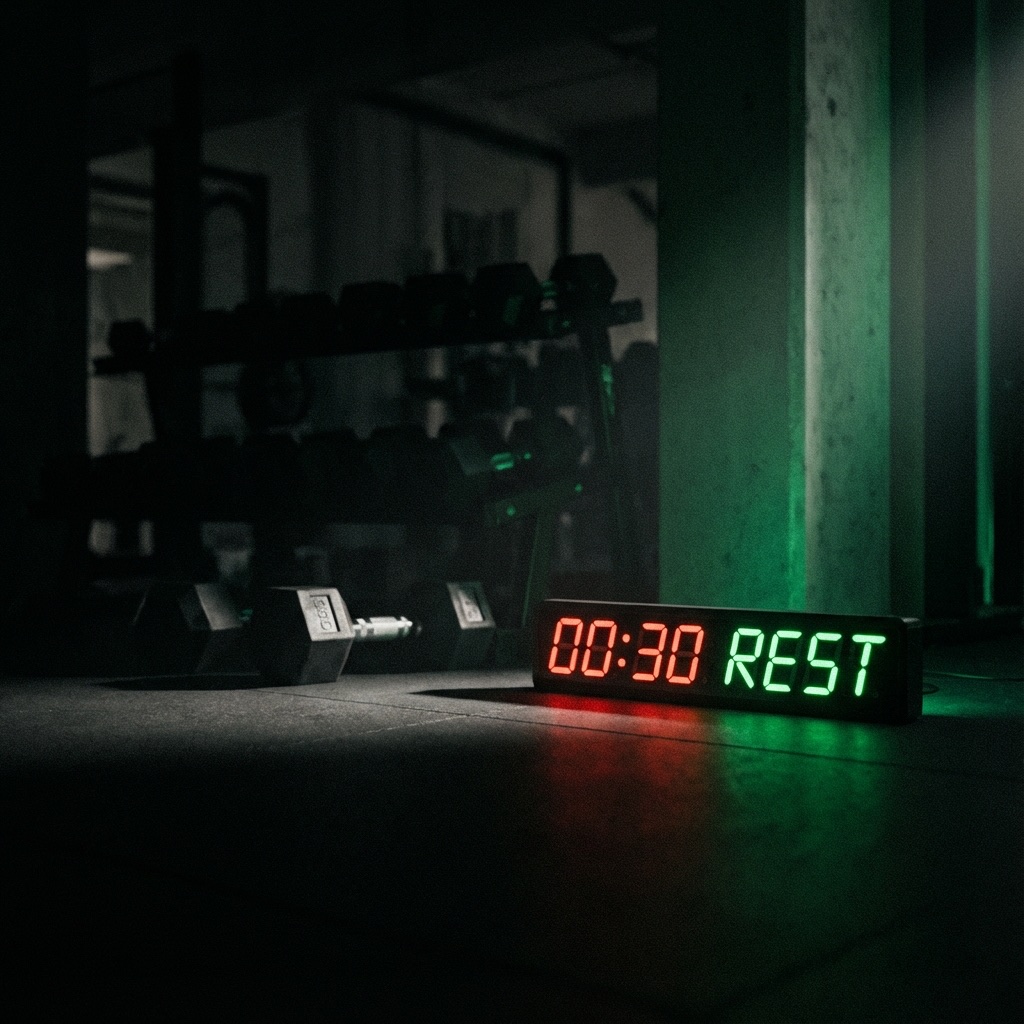
That guy scrolling Instagram for 8 minutes between bicep curls? Wasting time. The lifter who rushes through 30-second rests on heavy squats? Sabotaging their gains. Rest periods aren't filler—they're programming.
How long you rest between sets directly affects your performance, muscle growth, and strength gains. Rest too little and you can't maintain intensity. Rest too long and you waste time without additional benefit.
This guide gives you specific rest recommendations for every training goal and exercise type, plus the science behind why these numbers work.
Why Rest Matters More Than You Think
During a hard set, your muscles deplete their immediate energy stores (ATP and phosphocreatine) and accumulate metabolic byproducts. Rest allows:
- ATP resynthesis: Your primary energy currency replenishes—about 50% in 30 seconds, 75% in 60 seconds, 95% in 3 minutes
- Phosphocreatine restoration: The "explosive power" system recovers similarly to ATP
- Metabolite clearance: Hydrogen ions and other fatigue-causing substances dissipate
- Neural recovery: Your nervous system recharges for maximum muscle recruitment
The goal isn't maximum rest—it's optimal rest. Enough to perform well on the next set, not so much that you lose the training effect or waste time.
A 2016 study by Schoenfeld et al. found that 3-minute rest periods produced significantly more muscle growth and strength gains than 1-minute rests, primarily because subjects could maintain higher training volumes with longer rest.
Rest Periods by Training Goal
Your primary training goal determines your baseline rest periods. Here's what the research supports:
| Goal | Rep Range | Rest Period | Why |
|---|---|---|---|
| Maximum Strength | 1-5 reps | 3-5 minutes | Full neural recovery for peak force output |
| Strength-Hypertrophy | 5-8 reps | 2-4 minutes | Balance between recovery and metabolic stress |
| Hypertrophy | 8-12 reps | 2-3 minutes | Maintain volume while accumulating fatigue |
| Muscular Endurance | 12-20+ reps | 60-90 seconds | Challenge metabolic systems under fatigue |
| Power/Explosiveness | 1-5 reps | 3-5 minutes | Maximum velocity requires full recovery |
Notice that hypertrophy doesn't require short rests. The old "60-90 seconds for size" advice was based on the metabolic stress hypothesis. Current research shows that maintaining training volume matters more than accumulated metabolic stress.
Rest Periods by Exercise Type
Beyond your training goal, the exercise itself affects optimal rest. Larger movements with more muscle mass require longer recovery:
Heavy Compound Lifts (3-5 minutes)
Squat, deadlift, bench press, overhead press, barbell row. These movements recruit massive amounts of muscle tissue and create significant systemic fatigue. Rushing rest here directly limits your performance.
Moderate Compounds (2-3 minutes)
Leg press, Romanian deadlift, dumbbell press variations, cable rows. Still demanding but less systemically fatiguing than barbell compounds.
Isolation Exercises (60-120 seconds)
Bicep curls, tricep extensions, lateral raises, leg curls. Single-joint movements with less muscle mass recover faster. You can use shorter rests without performance loss.
Machine Exercises (60-90 seconds)
The stability provided by machines reduces neural demand. Combined with typically being isolation movements, machines allow shorter rest periods.
| Exercise | Minimum Rest | Optimal Rest | Notes |
|---|---|---|---|
| Squat | 2:30 | 3-5 min | Extend on heavy singles/doubles |
| Deadlift | 3:00 | 4-5 min | Most systemically fatiguing lift |
| Bench Press | 2:00 | 2-4 min | Less systemic demand than legs |
| Barbell Row | 2:00 | 2-3 min | Lower back fatigue accumulates |
| Overhead Press | 2:00 | 2-3 min | Smaller muscles, less rest needed |
| Leg Press | 2:00 | 2-3 min | Less systemic than squats |
| Lat Pulldown | 1:30 | 2 min | Machine stability reduces demand |
| Dumbbell Curls | 1:00 | 60-90 sec | Small muscle, quick recovery |
| Lateral Raises | 0:45 | 60 sec | Can superset with other shoulders |
| Leg Curls | 1:00 | 60-90 sec | Isolation, machine-based |
The Science of Between-Set Recovery
Understanding what happens during rest helps you make better decisions:
The ATP-PCr System
For efforts under 10 seconds (heavy singles, explosive movements), you rely primarily on stored ATP and phosphocreatine. This system recovers quickly:
- 30 seconds: ~50% recovery
- 60 seconds: ~75% recovery
- 2 minutes: ~85% recovery
- 3 minutes: ~95% recovery
- 5 minutes: ~99% recovery
The Glycolytic System
For sets lasting 30-90 seconds (typical hypertrophy work), glycolysis becomes the dominant energy pathway. This creates hydrogen ions that cause the "burn" and limit performance. Full clearance takes 3-5 minutes, but 2-3 minutes allows adequate recovery for most purposes.
Neural Fatigue
Your nervous system fatigues independently of your muscles. Heavy weights require maximum motor unit recruitment, and this neural demand takes longer to recover than muscular fatigue. This is why heavy singles need 4-5 minutes even though the muscular work is brief.
The heavier you lift (relative to your max), the more important rest becomes. A set of 3 at RPE 9 needs more rest than a set of 10 at RPE 7, even though the set of 10 might "feel" harder due to metabolic fatigue.
Supersets and Paired Sets
Supersets let you work during rest periods without sacrificing recovery—if you pair movements correctly.
Antagonist Supersets (Recommended)
Pair opposing muscle groups. One recovers while the other works:
- Bench press + Barbell row
- Bicep curls + Tricep extensions
- Leg curls + Leg extensions
- Overhead press + Pull-ups
Non-Competing Supersets (Useful)
Pair movements that don't share muscles or create systemic fatigue:
- Bench press + Calf raises
- Squats + Face pulls
- Rows + Lateral raises
What to Avoid
Don't superset movements that:
- Share muscle groups (bench press + dips)
- Both create heavy systemic fatigue (squats + deadlifts)
- Require the same equipment in a busy gym
- Compromise form due to accumulated fatigue
Properly programmed antagonist supersets can cut workout time by 30-40% without reducing training volume or performance. A 90-minute session becomes 55-60 minutes.
Signals to Extend Your Rest
Sometimes you need more rest than your timer suggests. Watch for these indicators:
Performance Signals
- Bar speed significantly slower than the previous set
- Reps dropping more than expected (losing 2+ reps between sets)
- Grip or stability failing before target muscles fatigue
- Form breakdown on early reps
Physical Signals
- Heart rate still elevated above 80% of max after standard rest
- Breathing still heavy when starting next set
- Localized muscle fatigue preventing full range of motion
- Lightheadedness when getting into position
When to Push Through
Some fatigue is acceptable and even desirable. Don't extend rest just because you "feel tired." The question is whether fatigue is limiting your performance or just making you uncomfortable.
Practical Implementation
Set Default Rest Times by Exercise
Program your rest timer with exercise-specific defaults. Heavy compounds get 3 minutes, moderate compounds get 2 minutes, isolations get 90 seconds. Adjust from there.
Track Rest as a Variable
Log your rest periods like you log weight and reps. If you hit a PR after 4-minute rests, don't claim the same PR is valid with 2-minute rests. Consistency matters for progress tracking.
Use Autoregulation
Start your timer, but pay attention to readiness signals. If you're ready at 2 minutes, go. If you need 3:30, take it. The timer is a minimum, not a command.
Plan Your Supersets
Design pairings before you train. Grabbing random exercises for "efficiency" usually means compromised performance on both movements.
Adjust for Context
Sleep-deprived? Extend rest. Final sets of a long session? Extend rest. Deload week? Can reduce rest. Life stress high? You guessed it—extend rest.
Common Rest Period Mistakes
1. Rushing Heavy Compounds
Taking 90 seconds between heavy squat sets because "time is short" means you're not recovering enough to perform. You'd be better off doing fewer properly-rested sets than more under-recovered sets.
2. Over-Resting Isolation Exercises
Your biceps don't need 3 minutes between curl sets. You're not recovering anything meaningful after 90 seconds—you're just wasting time.
3. Ignoring Heart Rate
If your heart rate is still at 160 when you start your next set, you're not recovered regardless of what the clock says. Use heart rate as a readiness indicator.
4. Inconsistent Rest When Tracking Progress
If you benched 225 for 5 reps with 3-minute rest, comparing that to 225 for 5 reps with 1.5-minute rest is meaningless. Standardize rest when comparing performance.
5. Social Media During Rest
What should be 2 minutes becomes 4 minutes. Every set. For every exercise. Your 60-minute workout becomes 90 minutes with no additional benefit. Use a timer and stay focused.
Frequently Asked Questions
How long should you rest between sets for muscle growth?
For hypertrophy, rest 2-3 minutes between compound exercises and 60-90 seconds for isolations. Research shows longer rest (2-3 minutes) produces more muscle growth than short rest (1 minute) because you can maintain higher training volume with better form.
Do shorter rest periods burn more fat?
Marginally. Shorter rests increase heart rate and calorie burn, but the difference (about 50-100 calories per session) is easily offset by reduced performance. For fat loss, focus on total weekly activity and nutrition rather than rest manipulation.
Should I rest longer as I get stronger?
Yes. Heavier weights create more systemic fatigue. As you progress, you may need to extend compound lift rest from 2 minutes to 3-4 minutes to maintain performance across all sets.
What happens if I don't rest long enough?
Insufficient rest causes reduced reps on subsequent sets, form breakdown, accumulated fatigue limiting total volume, and potentially less muscle growth over time. If you can't match your previous set's performance, you need more rest.
Can I do other exercises while resting (supersets)?
Yes, if you pair non-competing muscles. Bench with rows works well because chest recovers while back works. Avoid pairing exercises that share muscles or create systemic fatigue like squats with deadlifts.
References
- Schoenfeld BJ, et al. Longer Interset Rest Periods Enhance Muscle Strength and Hypertrophy. J Strength Cond Res. 2016;30(7):1805-12. PubMed
- de Salles BF, et al. Rest interval between sets in strength training. Sports Med. 2009;39(9):765-77. PubMed
- Grgic J, et al. The effects of short versus long inter-set rest intervals in resistance training. Eur J Sport Sci. 2017;17(8):983-993. PubMed
- Willardson JM, Burkett LN. The effect of different rest intervals between sets on volume components and strength gains. J Strength Cond Res. 2008;22(1):146-52. PubMed
- Henselmans M, Schoenfeld BJ. The effect of inter-set rest intervals on resistance exercise-induced muscle hypertrophy. Sports Med. 2014;44(12):1635-43. PubMed
- Robbins DW, et al. The effect of a complex agonist and antagonist resistance training protocol on volume load. J Strength Cond Res. 2010;24(10):2573-80. PubMed
Smart Rest Timers, Built In
Gainz Pro automatically sets rest timers based on exercise type and your training goal. Just log your set and the timer starts.
Join the Waitlist →