
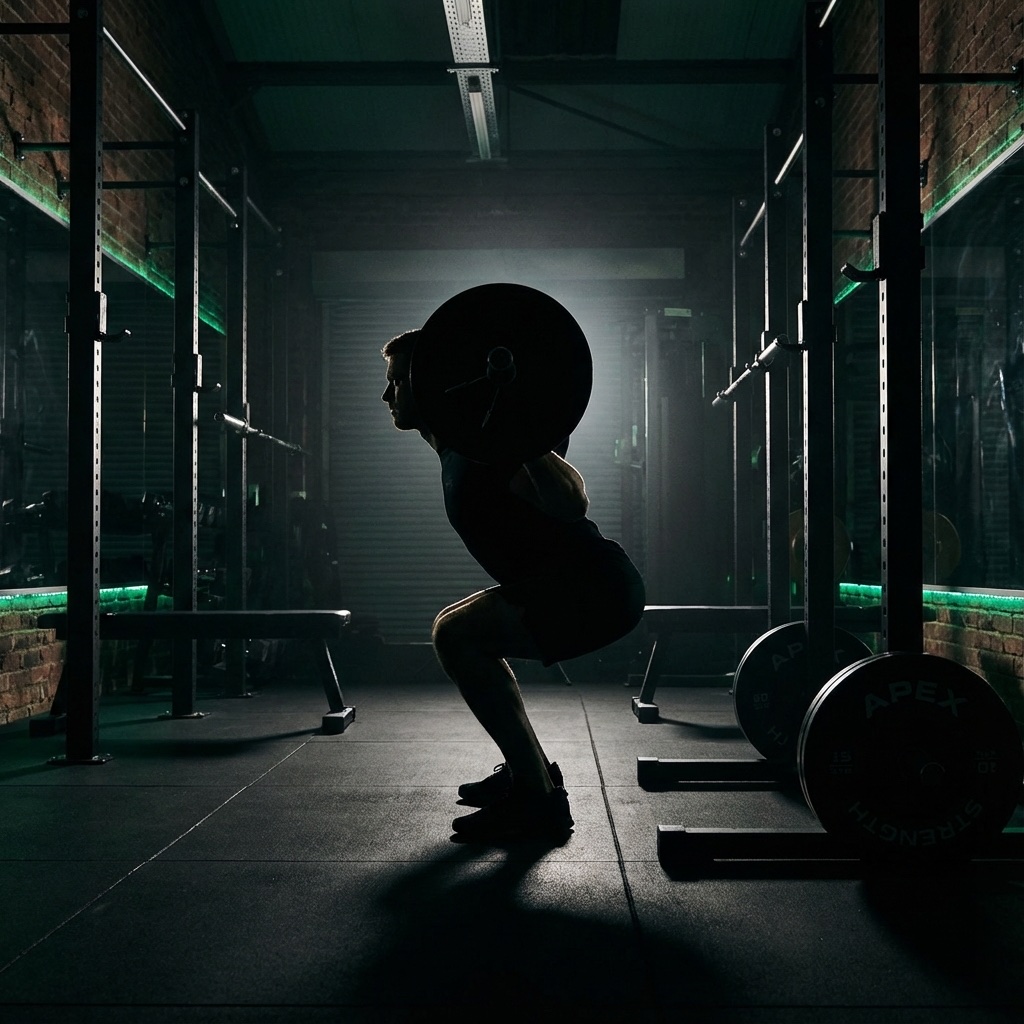
Your squat feels off but you can't pinpoint why. Your knees hurt after heavy sessions. You're stuck at the same weight for months. The problem is almost always technique—and it's fixable.
The squat is the most technically demanding lift for most people. Small errors compound under load: a knee that caves slightly at 135 lbs becomes a dangerous collapse at 315 lbs. This guide covers the six most common squat mistakes and exactly how to fix each one.
Why Squat Form Actually Matters
Good squat form isn't about looking pretty or satisfying internet form police. It's about three things:
- Safety: Poor form under load creates injury risk, especially to knees, hips, and lower back
- Efficiency: Good mechanics let you lift more weight with the same effort
- Muscle targeting: Proper form ensures quads, glutes, and intended muscles do the work
The goal isn't perfect textbook form. It's finding YOUR best form given your body proportions, mobility, and goals. Someone with long femurs will squat differently than someone with short femurs. Both can be correct.
Video yourself from the side and from 45 degrees behind. Most form issues are invisible without video. Watch at 0.5x speed and compare to the descriptions below.
Mistake #1: Knee Cave (Valgus)
Knee cave is when your knees collapse inward during the squat, especially on the way up. It's one of the most common issues and a significant injury risk factor.
Why It Happens
- Weak hip abductors: Glute medius and minimus can't control femur position
- Poor motor control: You haven't trained the pattern of keeping knees out
- Stance too narrow: Doesn't allow room for proper knee tracking
- Weight too heavy: Form breaks down under excessive load
How to Fix It
Use the "Spread the Floor" Cue
Imagine screwing your feet into the ground or spreading the floor apart with your feet. This activates hip external rotators and prevents knee cave.
Add Banded Squats to Warm-Up
Place a mini band above your knees. Perform 2-3 sets of 10 squats pushing out against the band before your working sets. This activates glutes and reinforces knee-out position.
Widen Your Stance
Try a slightly wider stance with toes pointed out 15-30 degrees. This gives your knees room to track properly over your toes.
Reduce Weight Until Controlled
If knees cave with current weight, drop 10-20% and rebuild. Better to progress with good form than grind through bad patterns.
Mistake #2: Butt Wink
Butt wink is posterior pelvic tilt at the bottom of a squat—your lower back rounds and pelvis tucks under. Slight butt wink is common; excessive butt wink under load is problematic.
Why It Happens
- Limited hip flexion mobility: Hips can't flex enough, so pelvis compensates
- Limited ankle dorsiflexion: Knees can't travel forward, shifts stress to hips
- Squatting too deep: Going past your mobility allows
- Poor bracing: Core can't maintain spinal position under load
How to Fix It
- Find YOUR depth: Squat only as deep as you can maintain a neutral spine. Use a box or target to find this depth and train there.
- Improve hip mobility: 90/90 stretches, pigeon pose, and hip flexor stretches done consistently (not just before lifting)
- Improve ankle mobility: Wall ankle stretches, heel-elevated squats, or squat shoes with raised heels
- Brace harder: Big breath into belly, hold against core, maintain through entire rep
- Try different stance widths: Some people butt wink less with wider stances; others with narrower. Experiment.
Minor butt wink with light loads is generally fine—your spine can handle some flexion. Significant butt wink under heavy loads repeatedly is a risk factor for disc issues. The solution isn't to avoid squatting; it's to find the depth where YOUR spine stays neutral.
Mistake #3: Excessive Forward Lean
Some forward lean in the squat is normal, especially in low-bar position. But excessive forward lean shifts stress from quads to lower back and makes the lift harder than necessary.
Why It Happens
- Weak quads: Body shifts to stronger posterior chain
- Limited ankle mobility: Heels rise or knees can't travel forward
- Long femurs: Biomechanically requires more forward lean
- Bar position too low: Creates more forward torso angle
How to Fix It
- Front squats: Force upright posture; strengthen quads in that position
- Heel-elevated squats: Plates under heels or squat shoes allow more upright torso
- Tempo squats: 3-second descent forces control and prevents dive-bombing
- Cue "chest up": Think about leading with your shoulders, not your hips, out of the hole
- Try high-bar position: Places bar higher on traps, allows more upright torso
| Issue | Quick Test | Primary Fix |
|---|---|---|
| Weak quads | Good morning pattern on every rep | Front squats, leg press |
| Poor ankle mobility | Heels rise at bottom | Squat shoes, ankle stretches |
| Long femurs | Forward lean even with good mobility | Accept more lean; strengthen back |
Mistake #4: Inconsistent or Insufficient Depth
Depth issues come in two forms: cutting squats high (not reaching parallel) and inconsistent depth rep to rep.
Why It Happens
- Mobility limitations: Can't physically get deeper
- Weight too heavy: Body protects itself by shortening range
- No depth reference: You don't know where parallel is
- Ego: More weight with less depth feels like progress
How to Fix It
- Box squats: Set a box at target depth; touch it on every rep. Removes guessing.
- Pause squats: 2-second pause at bottom builds awareness and strength at depth
- Video every session: You can't fix what you can't see
- Reduce weight: Hit proper depth before adding load. Always.
- Address mobility: If you physically can't hit depth, work on hips and ankles
Mistake #5: Inefficient Bar Path
The bar should travel in a straight vertical line over your midfoot. Any deviation forward or backward means wasted energy and potential balance issues.
Common Bar Path Errors
- Bar drifts forward: Often from losing upper back tightness or excessive forward lean
- Bar drifts backward: Usually from hips shooting up faster than shoulders
- Inconsistent path: Different bar path each rep indicates motor control issues
How to Fix It
- Video from the side: Draw a line from starting position; watch for deviation
- Cue "elbows under bar": Keeps upper back tight and prevents bar drift
- Focus on "hips and shoulders rise together": Prevents hips shooting up first
- Pin squats: Set safeties at sticking point; pause there each rep to build control
Mistake #6: Poor Bracing and Breathing
Bracing is the foundation of a strong squat. Without proper intra-abdominal pressure, your spine isn't protected and force transfer is inefficient.
Signs of Poor Bracing
- Lower back rounds at heavy weights
- You hold your breath in your chest, not belly
- You exhale during the hardest part of the lift
- Your core feels like the weak link
How to Brace Correctly
Breathe Into Your Belly
Take a big breath—but not into your chest. Breathe into your belly, expanding your midsection 360 degrees (front, sides, and back).
Brace Against That Breath
Once your belly is full, tighten your abs as if bracing for a punch. You should feel pressure all around your midsection.
Hold Through the Rep
Maintain the brace through the entire rep. Don't exhale until you're past the sticking point on the way up.
Reset Between Reps
For heavy sets, reset your brace between each rep. Quick breath out, big breath in, brace, squat.
How to Video Review Your Squat
Video review is the most valuable free tool for improving your squat. Here's how to do it effectively:
Camera Angles
- Side view (90 degrees): Shows bar path, depth, forward lean, back angle
- Rear 45-degree angle: Shows knee tracking, hip shift, bar tilt
- Front view: Shows knee cave, bar tilt, weight distribution
What to Look For
- Is the bar path vertical over midfoot?
- Do knees track over toes or cave in?
- Does lower back round at bottom (butt wink)?
- Is depth consistent rep to rep?
- Do hips and shoulders rise at the same rate?
Most form issues are invisible at full speed. Slow the video down and watch the descent and ascent separately. The transition from descent to ascent is where most breakdowns occur.
Frequently Asked Questions
Why do my knees cave in when I squat?
Knee cave typically results from weak hip abductors, poor motor control, or stance issues. Fix it by cueing "knees out," strengthening glutes with banded work, widening your stance slightly, or reducing weight until you can control knee position.
What is butt wink and is it dangerous?
Butt wink is posterior pelvic tilt at the bottom of a squat—your lower back rounds as your pelvis tucks under. Minor butt wink with light loads is generally fine. Significant butt wink under heavy loads can stress the lumbar spine. Fix it by improving mobility or stopping at a depth where your spine stays neutral.
How deep should I squat?
For most lifters, squat to where your hip crease drops below your knee (parallel or slightly below). Go as deep as you can while maintaining a neutral spine and proper knee tracking. If form breaks down at depth, stop higher and work on mobility.
Why do I lean forward too much?
Excessive forward lean usually indicates weak quads, poor ankle mobility, or bar position issues. Fix it with front squats, heel-elevated squats, ankle mobility work, and the cue "chest up, lead with shoulders" out of the hole.
Should my knees go past my toes?
Yes, knees past toes is normal and necessary for most people. The old "knees behind toes" advice increases hip and back stress while reducing quad engagement. Focus on keeping your whole foot planted and knees tracking over (not caving past) your toes.
References
- Schoenfeld BJ, Grgic J, Ogborn D, Krieger JW. Strength and hypertrophy adaptations between low- vs. high-load resistance training: a systematic review and meta-analysis. J Strength Cond Res. 2017;31(12):3508-3523. PubMed
- Hartmann H, Wirth K, Klusemann M. Analysis of the load on the knee joint and vertebral column with changes in squatting depth and weight load. Sports Med. 2013;43(10):993-1008. PubMed
- Fry AC, Smith JC, Schilling BK. Effect of knee position on hip and knee torques during the barbell squat. J Strength Cond Res. 2003;17(4):629-633. PubMed
- McKean MR, Dunn PK, Burkett BJ. The lumbar and sacrum movement pattern during the back squat exercise. J Strength Cond Res. 2010;24(10):2731-2741. PubMed
- Swinton PA, Lloyd R, Keogh JW, Agouris I, Stewart AD. A biomechanical comparison of the traditional squat, powerlifting squat, and box squat. J Strength Cond Res. 2012;26(7):1805-1816. PubMed
- Clark DR, Lambert MI, Hunter AM. Muscle activation in the loaded free barbell squat: a brief review. J Strength Cond Res. 2012;26(4):1169-1178. PubMed
Track Your Squat Progress
Gainz Pro tracks your squat PRs, records form notes, and shows strength trends over time. See exactly when form improvements translate to weight increases.
Join the Waitlist →