
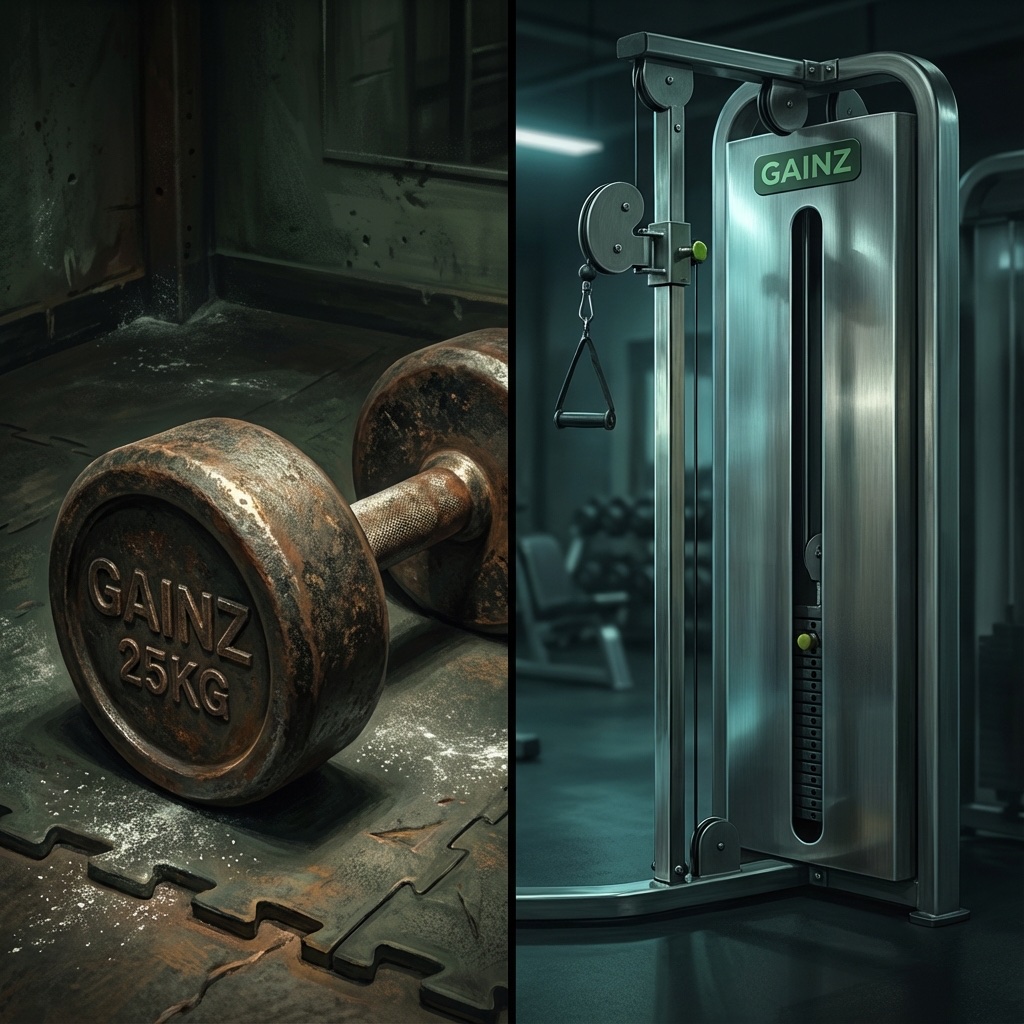
Free Weights vs. Machines: Which is Better for Hypertrophy?
The usual debate starts with a false choice. A barbell squat and a leg press are not competing brands of the same exercise; they are different movement tasks with different stability demands, resistance profiles, setup constraints, and skills. Both can challenge the legs. Which one belongs in your program depends on the adaptation you want and the cost of producing it.
What research says about muscle and strength
Two systematic reviews comparing machine-based and free-weight resistance training found no clear difference in muscle hypertrophy on average. The evidence base is not enormous, and the exercises, participants, and measurement methods vary, so “no detected difference” is not proof that every machine and free-weight movement is interchangeable. It does reject the blanket claim that one category is required to build muscle.
Strength results follow specificity. People who train free-weight movements tend to improve more on free-weight tests; people who train machine movements tend to improve more on those machine tests. If your outcome is a barbell squat one-repetition maximum, practice the barbell squat. If your goal is general lower-body hypertrophy, a well-fitted leg press may be just as legitimate a primary movement.
The trade-offs that matter
Skill and stability
A free-weight exercise asks you to control the implement through space. That can be valuable when coordination and free-weight skill are part of the goal. It can also mean that balance, bracing, or technique ends a set before the target muscle is strongly challenged. A machine constrains some of those degrees of freedom, often letting the lifter focus effort on producing force. “More stable” does not automatically mean “better isolation,” and instability is not a bonus unless it serves the outcome.
Resistance profile and body fit
Dumbbells and barbells are governed by gravity, while cable and plate-loaded machines can change the direction or leverage of resistance through the range of motion. Neither profile is universally ideal. A good exercise keeps the target working through a useful, controlled range without forcing your joints into an unsuitable path. Machine designs differ substantially: adjust the seat, pads, and start position, and reject a machine that simply does not fit you.
Fatigue and proximity to failure
Stable machines can make it simpler to take a set close to failure without balance becoming the limiter. They may therefore be useful late in a session, during higher-repetition work, or when a training partner is unavailable. That does not make every machine automatically safe. Pin settings, joint position, and controlled exits still matter. Heavy free weights can also be trained safely with sound technique, appropriate progression, spotters, and correctly set rack safeties.
Progression and availability
The best hypertrophy movement is one you can repeat and progressively load. Barbells usually offer small, standardized load jumps and broad availability. Some machines have coarse weight-stack increments, inconsistent labels, or friction that makes loads incomparable between gyms. Machines also offer quick setup and can remove the time cost of loading plates. Log the exact variation, machine, seat setting, load, reps, and effort so your comparison remains meaningful.
Choose by goal, not ideology
- Powerlifting: center the squat, bench press, and deadlift because the sport tests those skills. Add machines when they deliver useful muscle work without excessive skill fatigue.
- Hypertrophy: use either category. Prioritize target-muscle challenge, a stable setup, a productive range of motion, and a progression path.
- General strength: choose a small set of movements you enjoy and can perform consistently. Include free-weight skill only to the extent that it matters to you.
- Training around a limitation: select tolerable movements with a qualified clinician or coach when needed. “Machine” and “free weight” are not medical prescriptions.
Two example hypertrophy sessions
Mixed lower-body day
- Barbell or safety-bar squat: 3 sets of 5–8
- Leg press: 3 sets of 8–12
- Machine leg curl: 3 sets of 10–15
- Dumbbell Romanian deadlift: 2 sets of 8–12
- Calf machine: 3 sets of 8–15
Machine-forward upper-body day
- Converging chest press: 3 sets of 6–10
- Chest-supported row: 3 sets of 6–10
- Cable pulldown: 3 sets of 8–12
- Dumbbell lateral raise: 3 sets of 10–20
- Cable curl and pressdown: 2–3 sets each
These are examples, not universal prescriptions. Begin with a recoverable number of sets, keep most sets near but not necessarily at failure, and progress repetitions or load while execution remains comparable. You do not need to replace a productive movement just to create novelty.
When should you switch?
Switch when the goal changes, the equipment no longer fits, progression has genuinely stalled across several exposures, or the exercise creates persistent discomfort despite sensible adjustments. First check sleep, nutrition, effort, technique, and overall program fatigue. One flat session is not a plateau, and routine rotation can hide whether you are actually getting stronger.
The practical answer is simple: use free weights where their skill and flexibility help; use machines where their stability and setup help. Judge individual exercises, not categories.
Sources
- Haugen ME, et al. Free-weight versus machine-based strength training: a systematic review and meta-analysis. BMC Sports Sci Med Rehabil. 2023. PubMed
- Heidel KA, et al. Machines and free-weight exercises: changes in muscle size, strength, and power. J Sports Med Phys Fitness. 2022. PubMed
- American College of Sports Medicine. Progression models in resistance training for healthy adults. Med Sci Sports Exerc. 2009. PubMed
Make your next workout count.
Log sets fast, track progressive overload, and know what to beat next.
iOS 17+ · Offline workout logging