
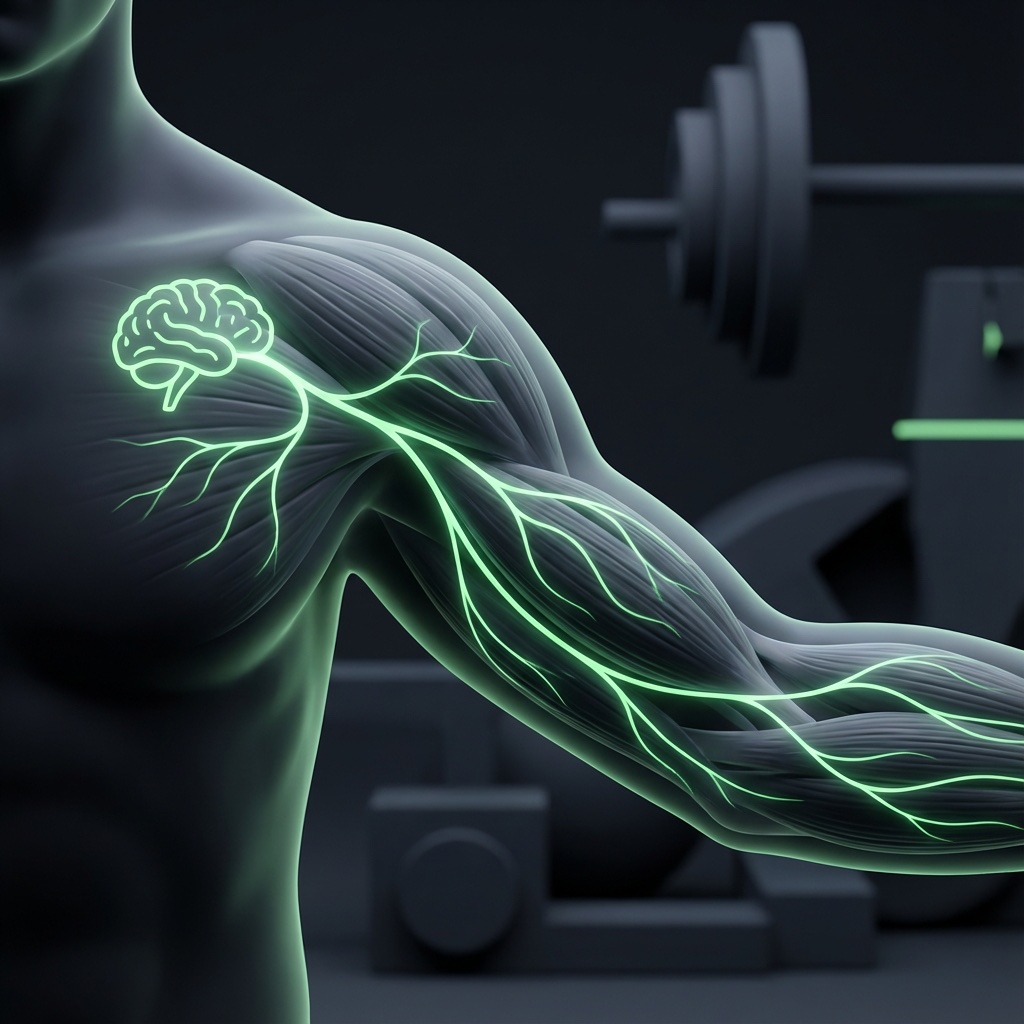
Mind-Muscle Connection: Broscience or Real Science?
Attention changes how a lifter organizes a movement. An internal focus directs attention toward the body—“contract your biceps” or “feel the pec shorten.” An external focus directs attention toward the movement outcome—“drive the floor away,” “move the bar toward the ceiling,” or “pull the handle to your hip.” The mind-muscle connection is the internal version, not a separate physiological mechanism.
What the research shows
Muscle activity can change
In a study of resistance-trained men performing the bench press, consciously focusing on the chest or triceps increased surface electromyography (EMG) activity in the named muscle at loads from 20% to 60% of one-repetition maximum. The effect was not observed at 80%, where the demand of moving the heavy bar may have constrained how selectively participants could alter recruitment.
This is useful evidence that a cue can change the immediate task, but EMG amplitude is not a direct measure of muscle growth. It is affected by electrode placement, anatomy, movement, and signal processing. Higher activity during one set does not guarantee superior hypertrophy over months.
Long-term hypertrophy evidence is limited
One randomized study assigned untrained young men to eight weeks of resistance training with either internal or external cues. The internal-focus group increased elbow-flexor thickness more, while quadriceps growth was similar between groups. That difference is interesting, especially because the arm curl offers a simple target and movement. It is not a universal verdict: the sample was small and untrained, the intervention was short, and the finding did not repeat across both measured muscle groups.
External focus often supports output
A meta-analysis of attentional-focus studies found a small acute strength advantage for external focus. Long-term strength evidence was sparse, though the review reported a possible lower-body strength benefit. When load, velocity, or skilled coordination is the priority, focusing on the implement or intended movement outcome is usually the sensible default.
Match the cue to the training goal
Use internal focus when the muscle is the target
Internal cues fit stable, moderate-load hypertrophy work where the purpose is to challenge a specific muscle and output is not being tested. Good candidates include curls, cable flyes, lateral raises, leg extensions, and leg curls. Keep the cue short and anatomical: “shorten the biceps,” “bring the upper arm toward the torso with the lat,” or “extend the knee with the quad.”
The cue should improve the repetition, not create theater. Do not twist the wrist, distort joint position, or shorten the range merely to manufacture a stronger sensation. A muscle can work hard without burning, cramping, or producing an intense pump.
Use external focus when performance is the target
For heavy squats, presses, deadlifts, Olympic lifts, and explosive work, give attention to the task: “push the platform away,” “drive the bar up,” or “throw the implement.” These cues leave the nervous system to coordinate multiple joints without consciously micromanaging each muscle. Technical cues can still reference body position—such as maintaining a stacked torso—but piling several internal instructions onto a maximal set usually adds noise.
Use process cues when learning technique
Some sets are neither pure hypertrophy nor maximal performance; they are practice. Choose one cue tied to the most important error. A row that becomes a shrug may respond to “pull the elbow toward the back pocket.” A squat that loses balance may respond to “keep pressure over the midfoot.” Film a set when possible: feeling and execution do not always match.
A practical cueing protocol
- Define the set’s job. Is it testing strength, practicing a skill, or loading a target muscle?
- Choose one cue. More instructions are not necessarily better. Use the same cue across several sessions before judging it.
- Run a warm-up comparison. Perform one controlled set with your normal focus and one with the candidate cue at the same load. Compare technique, target-muscle sensation, reps in reserve, and video—not sensation alone.
- Keep the cue only if performance supports it. If it improves target control without reducing useful range or output, use it. If it makes the movement awkward, discard it.
- Log it. Note the cue beside the exercise so next week’s set uses the same setup and has a fair comparison.
Examples that stay specific
- Dumbbell curl, 10–15 reps: “Keep the upper arm quiet; shorten the biceps.” Use a controlled range and stop before the shoulder rolls forward.
- Cable lateral raise, 12–20 reps: “Move the upper arm out with the side delt.” Do not chase a burn by turning the set into a shrug.
- Bench press, heavy set: “Drive the bar up and slightly back.” Save pec-focused experimentation for lighter accessory pressing.
- Lat pulldown, 8–12 reps: “Pull the elbows toward the hips.” This external result may also create a useful internal sense of the lats without forcing it.
- Squat, technique work: “Push the floor away while staying over midfoot.” Judge the cue by bar path and repeatability.
Limitations and common mistakes
The current literature does not establish that an internal focus is required for hypertrophy or that lifters who cannot “feel” a muscle are failing to train it. Individual anatomy, exercise selection, fatigue, and familiarity all affect sensation. Conversely, moving more weight is not automatically better if range of motion and control collapse.
A cue is a coaching tool, not a treatment. Sharp, radiating, or worsening pain is not evidence of a stronger connection; stop the exercise and seek qualified assessment when appropriate. For healthy training, the decision rule is simpler: use internal focus selectively for target-muscle work and external focus when force, speed, or coordinated performance matters most.
Sources
- Calatayud J, et al. Importance of mind-muscle connection during progressive resistance training. Eur J Appl Physiol. 2016. PubMed
- Schoenfeld BJ, et al. Differential effects of attentional focus strategies during long-term resistance training. Eur J Sport Sci. 2018. PubMed
- Grgic J, et al. Acute and long-term effects of attentional-focus strategies on muscular strength: a meta-analysis. Sports. 2021. PubMed
Make your next workout count.
Log sets fast, track progressive overload, and know what to beat next.
iOS 17+ · Offline workout logging