
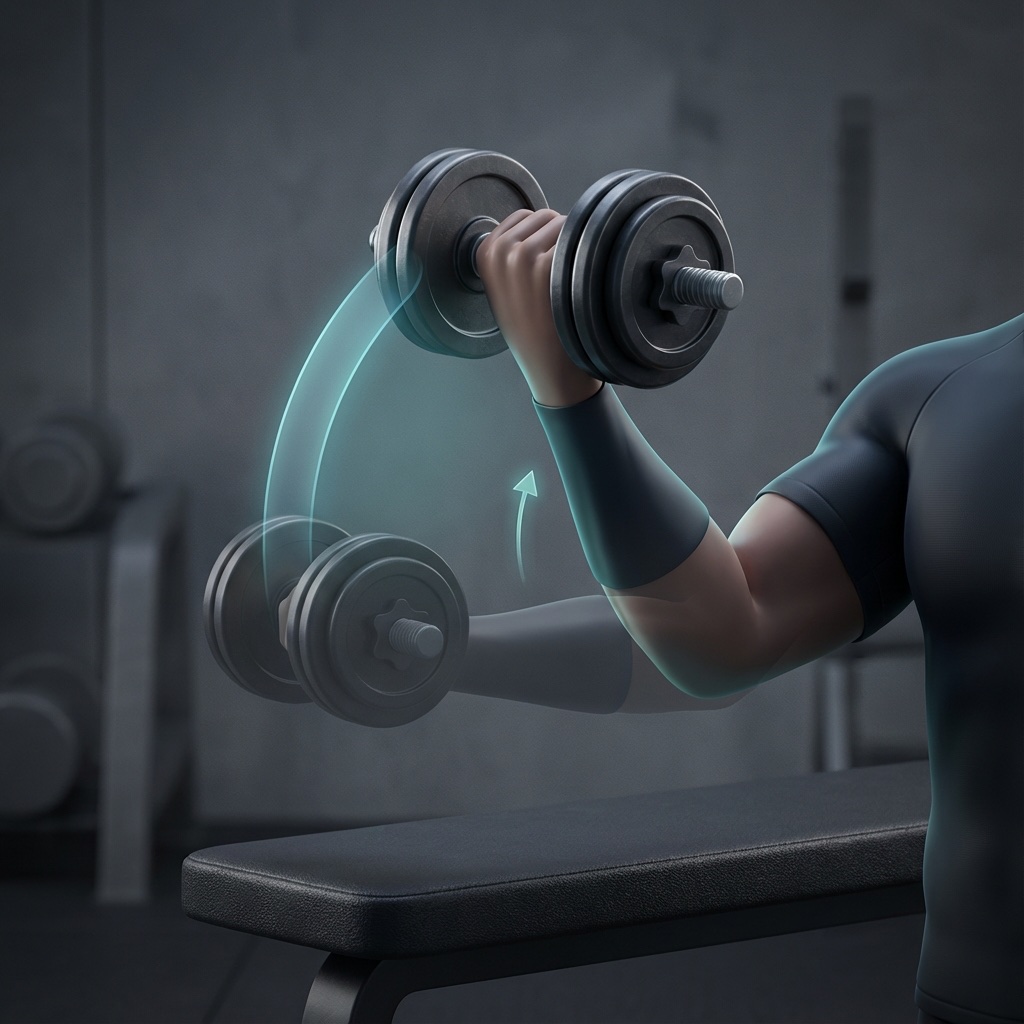
Partial Reps vs. Full Range of Motion: What Does the Science Say?
Range of motion is part of the exercise prescription. Changing it changes the joint angles trained, the length of the working muscle and often the load you can move. “Partial rep” is therefore not one method: a controlled rep in the stretched half of a calf raise is a different stimulus from bouncing through the easiest few centimeters of a squat.
Define the three options
Full range of motion
A full rep travels through the intended start and finish positions that you can control for that exercise. It does not require forcing every joint to its anatomical limit. Limb lengths, equipment geometry, training history and symptoms all affect an appropriate range. The standard should be repeatable depth and position, not a generic visual rule.
Lengthened partials
These train the portion where the target muscle is relatively long: near the bottom of a standing calf raise, near elbow extension in a preacher curl, or the more knee-flexed portion of a knee extension. The exact “long” position is muscle- and exercise-specific. It should feel loaded and controlled, not like an aggressive passive stretch.
Shortened partials
These emphasize the contracted end of an exercise, such as the top portion of a cable curl. They can be useful for sport-specific joint angles, accommodating a sticking point or extending a set, but current hypertrophy evidence is less favorable than for full range or long-length partials in several studied muscles.
What the research actually shows
A 2021 systematic review and meta-analysis favored full range over partial range for strength and lower-body hypertrophy overall. That remains a good reason to use full reps as the default. Strength is also specific: if you only train half of a movement, your largest improvement is likely to occur in that trained half.
Newer studies add an important qualification. In knee extensions, long-length partials produced greater growth at some quadriceps measurement sites than full or short-length conditions. In calf raises, long-length partials produced more gastrocnemius growth than full or shortened partials. A 2025 within-participant study in trained lifters found similar upper-body adaptations from lengthened partials and full reps over eight weeks.
These findings do not establish a universal winner. Most trials are short, use one or a few exercises, and measure specific muscle regions. They show that the stretched portion can matter—not that full range has become obsolete or that every exercise is safe to load deeply.
How to use partial reps without fooling yourself
Start with a stable full-ROM baseline
Record the range you intend to use and keep it consistent. If load rises while squat depth quietly falls, the logbook shows “progress” that may only reflect reduced work per repetition. Video from a fixed angle or a clear equipment marker can make range repeatable.
Add lengthened partials where the setup is clear
Choose an exercise with a stable path and an obvious long-muscle segment. After two or three full-range sets, perform one or two partial sets with a lighter load. Use a smooth turnaround, avoid bouncing, and stop the set when you can no longer hold the planned range.
- Calf raise: work from the controlled bottom stretch to roughly mid-range; do not rebound from the Achilles tendon.
- Preacher curl: use the lower portion while keeping the shoulder and upper arm stable; avoid snapping into elbow extension.
- Leg extension: work through the more knee-flexed portion with the machine adjusted comfortably; do not force a painful knee angle.
Keep overload comparable
Track full and partial versions as separate exercises. A 50-kilogram partial and a 50-kilogram full rep are not equivalent performances. Progress repetitions first inside a defined arc, then add the smallest practical load while preserving that arc.
A simple four-week experiment
- Choose one isolation exercise, not an entire program.
- Keep your normal two or three full-ROM work sets.
- Add one lengthened-partial set of 8–15 controlled reps, stopping with roughly 1–2 clean reps in reserve.
- If performance and next-session readiness stay stable for two weeks, add a second set or progress the load—not both at once.
- Remove the variation if range becomes less consistent, it disrupts the main work, or symptoms increase.
This approach gives the method a fair test while limiting the cost of being wrong. It also prevents novelty from replacing the basic work already producing progress.
Limitations and safety
No range of motion is automatically “joint friendly.” Long-muscle positions may create high tension, and short-range work can permit loads that exceed your control. Use a range you can own, change one variable at a time, and do not train through sharp or worsening pain. Persistent symptoms, sudden weakness, or loss of motion deserve assessment by a qualified clinician rather than an online technique rule.
Evidence and further reading
- Pallarés et al.: Range of motion and resistance-training adaptations (systematic review and meta-analysis, 2021).
- Pedrosa et al.: Partial ROM at long muscle lengths (randomized trial, 2022).
- Kassiano et al.: Long-length partial calf raises (controlled training study, 2023).
- Wolf et al.: Lengthened partials versus full ROM in trained lifters (within-participant study, 2025).
Make your next workout count.
Log sets fast, track progressive overload, and know what to beat next.
iOS 17+ · Offline workout logging